The Local Environmental Plan, as well as State Environmental Planning Policy’s contain development standards to provide restriction to development. These development standards are legislative and therefore ALL developments applications are required to comply with the various clauses. However, sometimes a proposed development achieves objectives of the LEP, but does not comply with specific development standards contained in the LEP. In these instances, it is necessary to request a “clause 4.6 variation” which allows a consent authority (usually the local Council) to relax the development standard in that particular circumstance. Under the EP&A Act a variation request under clause 4.6, must be made in writing and must address certain criteria. It should be stressed that the clause 4.6 report is a separate report to the statement of environmental effects.
The most common variations to development standards are:
- Minimum lot size restrictions (for subdivision)
- Minimum lot size restriction for certain development types (such as dual occupancies, residential flat buildings and tourist and visitor accommodation)
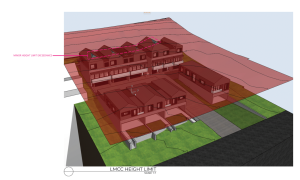
- Height of building (where a development doesn’t comply with the height limit)
- Floor Space Ratio (FSR) – Where a development has a gross floor area beyond the allowable FSR.
- Landscape area (restricting the amount of built upon area for a site)
Clause 4.6 variation can only be applied to development not complying with development standards and cannot be utilised for development prohibitions.
The term ‘development standards’ is defined in the Environmental Planning and Assessment Act 1979 as
“provisions of an environmental planning instrument or the regulations in relation to the carrying out of development, being provisions by or under which requirements are specified or standards are fixed in respect of any aspect of that development”.
Essentially, development standards are provisions in the legislation that specify how development is to be carried out (ie. building heights, minimum lot sizes, floor space ratio, etc).
However, a prohibition is a criteria which is essential to determining if a development is at all permissible.
What is required within a clause 4.6
When requesting a clause 4.6 variation, the objectives of the development standard as well as the extent to which the standard is being breached must be considered. According to the standard template LEP, applications must address whether:
(a) strict compliance with the standard, in the particular case, would be unreasonable or unnecessary and why,
(b) and demonstrate that there are sufficient environmental planning grounds to justify contravening the development standard.
Case law is utilised within a clause 4.6 variation request to provide guidance on how to address the requirements above.
Initial Action Pty Ltd v Woollahra Municipal Council [2018] NSWLEC 11 & Samadi v Council of the City of Sydney [2014] NSWLEC 1199.
In the case, Initial Action Pty Ltd v Woollahra Municipal Council [2018] NSWLEC 11 & Samadi v Council of the City of Sydney [2014] NSWLEC 1199.
Paragraph 27 of the judgement relates to preparing a clause 4.6:
Clause 4.6 of (the LEP) imposes four preconditions on the Court in exercising the power to grant consent to the proposed development.
The first precondition (and not necessarily in the order in cl 4.6) requires the Court to be satisfied that the proposed development will be consistent with the objectives of the zone (cl 4.6(4)(a)(ii)).
The second precondition requires the Court to be satisfied that the proposed development will be consistent with the objectives of the standard in question (cl 4.6(4)(a)(ii)).
The third precondition requires the Court to consider a written request that demonstrates that compliance with the development standard is unreasonable or unnecessary in the circumstances of the case and with the Court finding that the matters required to be demonstrated have been adequately addressed (cl 4.6(3)(a) and cl 4.6(4)(a)(i)).
The fourth precondition requires the Court to consider a written request that demonstrates that there are sufficient environmental planning grounds to justify contravening the development standard and with the Court finding that the matters required to be demonstrated have been adequately addressed (cl 4.6(3)(b) and cl4.6(4)(a)(i)).” [paragraph 27]
The variation request must show that there are legitimate planning grounds to justify the variation. It is not sufficient to simply showcase the perceived benefits of the development as a whole. The clause 4.6 variation request must focus on the particular standard to be varied.
What types of variations are appropriate
The development standards provide a legislative restriction to development in an attempt to shape development for an area. The application of these development standards is generally over a large area and does not consider existing development, site restriction or hazards that might impact the ability to comply with the numerical requirements of the control.
For example: John wants to build a house on his site. John has a big family and the parking on the street is always full so John wants to build a 2 storey dwelling with a garage underneath. All of his neighbours have 2-3 storey dwellings within the area so the size of the dwelling is compatible with the area. John’s lot is a steep site and his building designer has designed the building to step back into the site to reduce the excavation required to build the home. As a result of the design, a portion of the building breaches the height of building development standard for the area (8.5m). The portion of the building is where the dwelling steps back into the site to accommodate a three storey portion of the dwelling. It is noted that if John had wanted to excavate into the site the development would numerically comply with the height restriction but this would result in extensive excavation and cost for the build. A clause 4.6 report is appropriate for this type of development as strict compliance with the development standard would result in a worse scenario for the development.
Other examples is where the development standard doesn’t match the surrounding/existing development within the area. Examples of this are minimum lot size restriction of 800sqm for subdivision where all the surrounding lots are 500sqm.
It is possible to utilise a clause 4.6 report to push the envelope on development to get developments approved despite the substantial non compliance with the development standard. These development applications require a highly detailed clause 4.6 report that relies primarily on case law to justify the non compliance to the development standard.
How to calculate the Clause 4.6 variation percentage
As part of the clause 4.6 report the variation requested as a percentage is required to be stated. This is a requirement as certain Council policies for approval pathways (who essentially can sign off on a development) are based on the percentage of variation requested. Most developments with a clause 4.6 variation of 10% and over are required to go to a more formal panel style determination rather than being approved by a Council staff member. To calculate the percentage of the variation the following formula in the example below should be used.
Note: This applies to minimum lot size, FSR and height which are all types of Development standards. For the below example we will use FSR.
Example
John is seeking approval for a new house on a 1000sqm lot with an FSR of 0.57:1 (or Gross Floor Area of 570sqm). The site is mapped as having a max FSR of 0.5:1 (or GFA of 500sqm). The difference in floor area is 70sqm. To work out the percentage we will work out the difference and then find it out as a percentage of the allowable FSR.
FSR Difference = Proposed FSR (0.57) – Required FSR (0.55)
The FSR Difference in this instance is 0.07.
Variation Percentage = FSR Difference (0.07) / Required FSR (0.5) * 100
The variation percentage is therefore 14%.
The formula works for height and minimum lot size as well.
Who can prepare a clause 4.6
While it is possible to prepare your own clause 4.6 report or have it prepared by an architect or building designer, it is recommended that you seek expert assistance from a town planner to prepare any clause 4.6 variation request. It is important that the clause 4.6 report address the requirements under the legislation and is constructed in a way that best presents the variation to be considered by Council.
It’s important to ensure your application is completed thoroughly and professionally to ensure efficient and hassle-free processing through Council.